
Custom Keyrings: Which Type Suits Your Club or Brand?
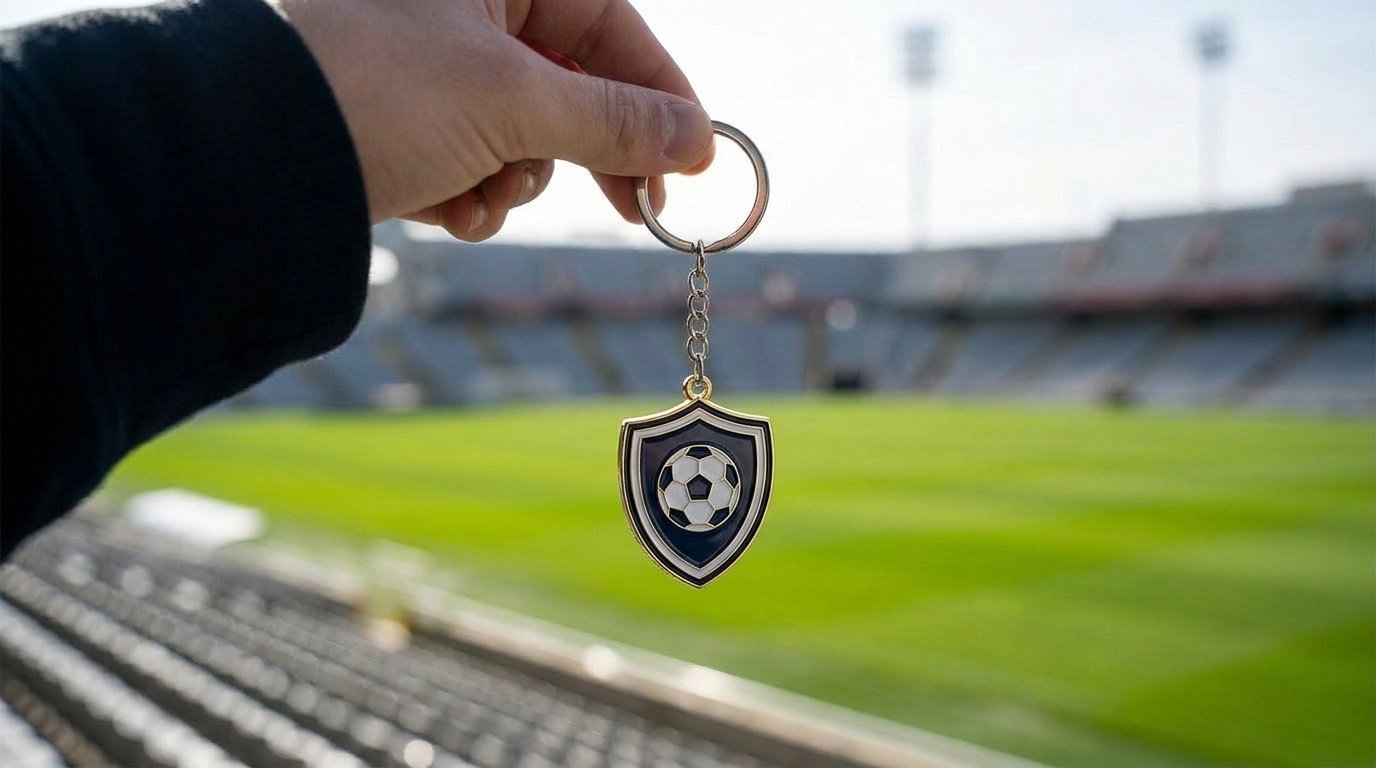
Custom keyrings are small metal or PVC pieces made to a client's own design, carrying a crest, logo or shape on a split ring, chain or clasp. Clubs, federations and brands order them for fan shops, gifts and events.
This guide compares the main keyring types and what each one suits, then covers finishes, fittings, cost, packaging, sampling, quality checks and the EU rules on nickel, plasticisers and toys. A worked example closes it: an anniversary keyring with a VIP edition.
Key Takeaways
- Choose the type by its job: die-struck enamel for flat crests, die-cast zinc alloy for 3D shapes, PVC for soft mascots, a bottle opener or trolley chip for daily use.
- Tooling, size, colours, plating, extra parts and packaging set most of the price, and quantity spreads the fixed costs.
- On the sample, test what fails first: edges, the joint between ring and body, plating at the edges, colour and any moving part.
- Plan the safety rules early: REACH limits nickel release from skin-contact articles and four phthalates in soft PVC, and a 3D figure with play value on a key ring counts as a toy.
- Count back from the launch date: approvals, sample rounds, production and shipping all take time.
In This Article
- Key Takeaways
- Which Types of Custom Keyrings Are There?
- Which Finish and Fittings Should You Choose?
- What Drives the Cost of Custom Keyrings?
- How Should Custom Keyrings Be Packaged?
- How Does an Order Run From Artwork to Delivery?
- What Should You Check on a Keyring Sample?
- Which Safety Rules Apply to Keyrings?
- Scenario: An Anniversary Keyring for the Shop and VIP Guests
Which Types of Custom Keyrings Are There?
Custom keyrings, called custom keychains in the US, come in five main constructions: die-struck metal with enamel, die-cast zinc alloy, soft PVC or rubber, function keyrings, and multi-part designs with a logo tag or a moving part. Each suits a different job.
Die-struck metal with enamel colour
A steel die stamps the design into a flat metal blank, and the recessed fields are filled with enamel. This is the natural choice for crests and logos with clear outlines. Soft enamel stays slightly below the metal lines, while hard enamel is polished level with them. The relief is shallow, so very fine text and colour gradients work better as print.
Die-cast zinc alloy for 3D shapes and cut-outs
For three-dimensional pieces, molten zinc alloy is forced into a steel mould under pressure. That gives depth, rounded forms and cut-outs in one piece: a trophy, a mascot, a stadium or a city skyline.
The alloy usually comes from the Zamak family, zinc alloys with aluminium and, in some grades, copper. According to the International Zinc Association, Zamak 5 is the most widely used zinc alloy in Europe and is readily plated. A 3D piece uses more metal, so it weighs more, and its casting seams have to be cleaned off.
PVC and rubber
Soft PVC or rubber is moulded in layers of colour, flat or with raised details. It is light and colourful, which suits mascots and younger fans. Plasticised material has its own chemical limits, covered below.
Function keyrings: bottle openers and trolley chips
A bottle opener or a shopping-trolley chip built into the body gives the keyring a daily job and keeps the crest in use. The function has to work. An opener that bends, or a chip that does not fit local trolleys, turns a gift into a complaint.
Logo tags and moving parts
A logo tag, a small flat piece hung next to a shaped main piece such as a trophy, keeps the crest readable without crowding the shape. A rotating centre or a two-part design adds a detail that collectors notice. Am Ball, an official Bundesliga licensee, has a Virtual Bundesliga keychain with a rotating centre piece in its range, and a two-piece Franz Beckenbauer Supercup keychain among its licensed 3D trophy keyrings. Every extra part is one more finish to match and one more joint to test.
Which type suits which occasion?
Keyrings are also a familiar promotional product, and promotional products are a large market. Germany is the world’s fourth-largest, with a GDP contribution of 14.9 billion euros, according to an Oxford Economics study that the German promotional products association GWW reported in September 2026 (in German). A low-cost giveaway and a weighty collectible both do their job, but they are different jobs.
Which Finish and Fittings Should You Choose?
Once the type is set, plating and colour decide the look and the fittings decide how the keyring is carried. Each choice changes the price and the checks on the sample.
Plating, finish and colour
Most metal keyrings are plated: a nickel undercoat, then a top plate such as gold, silver, copper or black nickel. The finish can be polished, matte or antique, where darkened recesses lift the relief, and two-tone plating adds a production step. The nickel layer is why the nickel rules below matter.
Enamel gives solid colour fields between metal lines, while printed designs under a clear epoxy dome can show photos and gradients. Whatever the route, give the producer colour references such as Pantone numbers, not screen colours.
Rings, chains and clasps
The usual fitting is a split ring, the flat double coil that keys slide onto. A short chain lets the piece hang, a swivel stops it twisting, and a lobster clasp clips the keyring to a bag or lanyard. Match the plating of the fittings to the body, and remember that every link and clasp is another joint that has to hold.
What Drives the Cost of Custom Keyrings?
Tooling, size, colours, plating, extra parts and packaging decide most of the price of custom keyrings, and quantity decides how far the fixed costs are spread. Licensed designs add royalties and approval rounds.
Orders at Am Ball typically start around 300 units. The other figures in this guide, from plating thickness and tolerances to lead times, are likewise typical values it works to with its manufacturing partners, not guarantees, so ask any producer for its own figures in writing.
How Should Custom Keyrings Be Packaged?
Shop keyrings usually hang on a header card or come in a polybag, and gift editions go in a box. The packaging also carries information the keyring has no room for.
Under the EU General Product Safety Regulation, which has applied since 13 December 2024, a product needs a type, batch or serial number and the manufacturer’s name and contact details. Where its size does not allow that, Article 9 lets them go on the packaging or in an accompanying document. For most keyrings, that means the header card or the box.
The card and the box are packaging in their own right, with duties for whoever counts as their manufacturer, as our guide to who the packaging manufacturer is under PPWR explains. For a VIP edition, a fitted insert stops the keyring rubbing against the lid.
How Does an Order Run From Artwork to Delivery?
An order runs from artwork through a production drawing, any rights-holder approval and a sample to mass production, inspection and shipping. On average, a sample takes 2 to 3 weeks and mass production about 4 weeks.
- Agree the purpose, quantity, date and budget, and supply vector artwork with colour references.
- The producer turns the artwork into a production drawing with size, thickness, colours, plating and fittings for your sign-off.
- If the design uses marks you do not own, such as a league logo, that rights holder approves the concept and later the sample, as our guide to how sports merchandise licensing works explains.
- Tooling is made and a physical sample produced.
- You and any rights holder approve the sample against the drawing.
- Mass production follows, its length depending on complexity and volume.
- The goods are inspected, packed and shipped, and shipping time comes on top.
These are averages, not promises. Each extra approval or sample round adds time.
What Should You Check on a Keyring Sample?
Check a keyring sample the way it will be used: in the hand, on a set of keys, at the bottom of a bag. These are the points where keyrings fail first.
- Run a finger along the outline, the cut-outs and the eyelet. Casting seams on die-cast pieces must be gone, or a sharp edge ends up in a pocket lining.
- Open and close the split ring, pull hard on ring, chain and clasp, and check that jump rings close without a gap.
- Rub the edges and the back of plated pieces; base metal showing through, or plating that flakes, is a fault. Typical plating is a 4 to 6 micron nickel undercoat under a 0.5 to 2 micron top plate, up to 3 microns for premium gold.
- On die-struck pieces, typical tolerances are about 0.15 mm on the outline and 0.1 mm on recessed detail lines, with enamel fields 0.4 to 0.6 mm deep.
- Compare colours with your references in daylight, including the logo tag against the main piece.
- Turn a rotating centre many times, open a real bottle and try the chip in a real trolley.
Keep the approved sample as the reference for the whole run. Our quality control checklist for metal merchandise covers how to document the approval.
Which Safety Rules Apply to Keyrings?
Keyrings sold to consumers should be treated as covered by the EU General Product Safety Regulation. Three further rules matter most: nickel for plated metal, phthalates for soft PVC and rubber, and the line between a keyring and a toy.
For plated metal, REACH Annex XVII, entry 27, caps nickel release at 0.5 micrograms per square centimetre per week for articles intended for direct and prolonged skin contact, measured on the parts that touch the skin. A coating over nickel must hold that limit for at least two years of normal use. Keys rub the plating every day, so ask for a nickel release test on the finished model; our guide to GPSR and nickel rules for metal pins and keychains explains how keyrings are classified.
For soft PVC and rubber, entry 51 of the same annex has, since 7 July 2020, banned articles in which DEHP, DBP, BBP or DIBP make up 0.1 percent or more of the plasticised material by weight, alone or combined. Printed designs and inks count as plasticised material too, so ask for a test report per PVC model.
The European Commission’s guidance on decorative products and products for collectors (November 2024) classes an animal, doll or other 3D figure with play value on a key ring as a toy. A flat keyring with low or no play value is not a toy. A 3D mascot keyring may therefore have to meet the toy safety rules, so settle this before the design is final.
Scenario: An Anniversary Keyring for the Shop and VIP Guests
A club celebrating its centenary wants two keyrings from one design: 1,000 pieces for its fan shop and 300 numbered pieces for sponsors and VIP guests. The design shows the anniversary crest, both years and a cut-out of the stadium roof, so it needs a die-cast piece.
The shop edition gets antique silver plating, soft enamel in the club colours, a split ring and a header card with the batch code. The VIP edition comes from the same mould with gold plating, a laser-engraved number and a fitted gift box, so both editions share one tooling cost. If the crest uses only the club’s own marks, the club approves internally; a league logo or a former sponsor’s mark brings those rights holders in too.
With one sample round, sample and mass production alone take about 6 to 7 weeks on average. Sign-offs, outside approvals, a possible second sample, a gift-box sample and shipping come on top, so the club counts back from the anniversary date and adds a buffer.
Frequently Asked Questions
What is the difference between die-struck and die-cast keyrings?
A die-struck keyring is stamped from flat metal and suits flat designs filled with enamel. A die-cast keyring is cast from molten zinc alloy in a mould, so it can have depth, rounded forms and cut-outs.
How long does it take to make custom keyrings?
It depends on approvals, sample rounds and shipping. As a guide, a sample takes 2 to 3 weeks and mass production about 4 weeks on average, with shipping on top; ask your producer for its own figures.
Are metal keyrings nickel-free?
Not necessarily, because plated keyrings often have a nickel undercoat. REACH caps nickel release from articles intended for direct and prolonged skin contact at 0.5 micrograms per square centimetre per week, so ask for a release test on the plated model.
Can a keyring count as a toy?
Yes, if a 3D figure with play value is attached. European Commission guidance classes an animal, doll or other figure on a key ring as a toy, and a flat keyring with low or no play value as not a toy.
What artwork do I need for a custom keyring?
Vector artwork, such as AI, EPS or PDF with outlined fonts, plus colour references like Pantone numbers and the intended size. If a rights holder’s marks appear, add its brand guidelines.
Conclusion
Custom keyrings work when the type matches the job: die-struck enamel for flat crests, die-cast zinc alloy for 3D shapes, PVC for soft mascots and a built-in function for daily use. Fix the type and finish first, check the sample where keyrings fail, and plan the packaging and safety documents together with the product.
If you are planning keyrings for a shop range, an event or an anniversary, get in touch about your next keyring collection.


