
EmpCo Directive: Which Green Claims Merchandise Can Carry
The EmpCo directive, Directive (EU) 2024/825, adds rules against greenwashing to EU consumer law. Since 27 September 2026, the national laws based on it ban generic green claims without recognised excellent environmental performance, uncertified private sustainability labels and offset-based climate claims for products.
This explainer shows which environmental claims on merchandise are banned or risky under the EmpCo directive and the amended German Act against Unfair Competition (UWG), what wording still works, and which proof to collect from suppliers. It draws on the legal texts, a Federal Court of Justice judgment and the European Commission’s questions and answers, and it is an explainer, not legal advice.
Key Takeaways
- Directive (EU) 2024/825 amends EU consumer law. Member states had to adopt their rules by 27 March 2026 and apply them from 27 September 2026.
- Germany transposed it with the Drittes Gesetz zur Änderung des Gesetzes gegen den unlauteren Wettbewerb (BGBl. 2026 I Nr. 43, in German), in force since 27 September 2026.
- Banned outright towards consumers: generic claims such as “eco-friendly” without recognised excellent environmental performance, sustainability labels without a certification scheme or public authority behind them, whole-product claims that cover one part, and offset-based climate claims for products.
- Specific, true and provable claims still work when the specification sits on the same tag or page.
- The rules cover old stock. In Germany, competitors and qualified associations enforce them, usually with a warning letter first.
In This Article
- Key Takeaways
- What Does the EmpCo Directive Change in EU Consumer Law?
- Which Green Claims Are Banned Outright?
- Which Claims Need a Case-by-Case Check?
- How Has Germany Implemented the EmpCo Directive?
- Claim by Claim: What Is Risky and What Works
- Which Proof Should You Collect From Suppliers?
- A Five-Step Claim Audit Before the Next Season
What Does the EmpCo Directive Change in EU Consumer Law?
The EmpCo directive amends two EU laws. It adds green-claim rules to the Unfair Commercial Practices Directive (UCPD, 2005/29/EC), which governs advertising to consumers, and point-of-sale information on guarantees, durability and repair to the Consumer Rights Directive (2011/83/EU). This explainer covers the UCPD part.
The UCPD has a blacklist in Annex I, with practices that are unfair in all circumstances, and case-by-case rules in Articles 6 and 7; the directive adds to both. The Commission explains the changes in its questions and answers of September 2026, where it calls the law the ECGT Directive.
The new definitions in Article 2 of the UCPD decide most merchandise cases:
- An environmental claim is any message the law does not require, in any form, including images, labels, brand names and product names, that states or implies a positive or zero environmental impact, less harm than others or an improvement over time.
- A generic environmental claim is a written or oral one, not on a sustainability label, whose specification is not given in clear and prominent terms on the same medium.
- A sustainability label is a voluntary trust mark or quality mark, public or private, that sets products or businesses apart for environmental or social characteristics.
- A certification scheme needs third-party verification, public terms, openness to all traders, requirements set with experts and stakeholders, rules for withdrawing the label, and monitoring by a third party independent of both the scheme owner and the trader.
- Recognised excellent environmental performance means meeting the EU Ecolabel, an officially recognised EN ISO 14024 type I ecolabel, or top environmental performance under other EU law.
Which Green Claims Are Banned Outright?
Five new points in Annex I matter most for merchandise. A claim that falls under one of them is unfair without any further test.
Generic claims (point 4a)
Point 4a bans a generic environmental claim if the trader cannot demonstrate recognised excellent environmental performance relevant to it. Recital 9 names “eco-friendly”, “green”, “ecological”, “climate friendly”, “biodegradable” and similar words.
Such wording survives in two ways. A specification in clear and prominent terms on the same medium makes it specific: recital 9 contrasts “climate-friendly packaging” with “100 % of energy used to produce this packaging comes from renewable sources”. Or the product has recognised excellent environmental performance, which the Q&A says can come from the EU Ecolabel, an officially recognised type I ecolabel such as the Blue Angel or the Nordic Swan, or top performance under other EU law.
“Sustainable” rarely survives. Recital 10 says claims such as “sustainable” or “responsible” should not rest on recognised excellent environmental performance alone, because they also refer to social characteristics.
Sustainability labels (point 2a)
Point 2a bans displaying a sustainability label that is not based on a certification scheme or established by public authorities. A badge a club designs for its own range, such as a leaf reading “Green Collection”, will rarely pass, and the Q&A notes that labels already in use got no transition period. Club colours are a different matter: according to the Q&A, green in a name or as a colour is not automatically an environmental claim where consumers would not expect an environmental benefit from it.
Whole-product claims, offsetting and legal duties
Point 4b bans a claim about the entire product when it concerns only one aspect. Recital 11’s example fits merchandise exactly: a product sold as “made with recycled material” when only its packaging is recycled.
Point 4c bans claiming, based on the offsetting of greenhouse gas emissions, that a product has a neutral, reduced or positive impact on the environment in terms of those emissions. Recital 12 lists “climate neutral”, “CO2 neutral certified” and “climate compensated” among its examples, and no proof saves such a claim. The Q&A adds that specified claims based on real reductions in the product’s own value chain remain possible, and that you may report funding of carbon credit projects if it does not mislead.
Point 10a bans presenting legal requirements that apply to every product of a category on the EU market as a distinctive feature of your offer. By that logic, a merchandise box should not be advertised for meeting what EU packaging law already requires of every pack; our guide to who the packaging manufacturer is under the PPWR covers those duties. Point 23g adds a ban on false durability claims, so “colourfast for 50 washes” needs a test behind it.
Which Claims Need a Case-by-Case Check?
Outside the blacklist, Article 6 of the UCPD judges claims case by case: a claim is misleading if it is false or likely to deceive the average consumer, and likely to change their decision. The directive adds environmental and social characteristics, durability, reparability and recyclability to the main characteristics covered (Article 1 of the directive). A line such as “made under fair working conditions” therefore needs proof as much as any green one.
Two new points in paragraph 2 of Article 6 target green marketing. Point (d) covers future claims, such as a post promising climate-neutral merchandise by 2030: they need clear, public and verifiable commitments in a detailed, realistic implementation plan with measurable, time-bound targets, regularly verified by an independent expert whose findings consumers can see. Point (e) covers irrelevant benefits, and recital 5 mentions paper sheets advertised as containing no plastic.
How Has Germany Implemented the EmpCo Directive?
Germany transposed the directive with the Drittes Gesetz zur Änderung des Gesetzes gegen den unlauteren Wettbewerb of 12 February 2026, published as BGBl. 2026 I Nr. 43 (in German). Its footnote names Directive (EU) 2024/825, and Article 2 puts the rules into force on 27 September 2026.
In the UWG (links in German), the new definitions sit in section 2, paragraph 2, from “allgemeine Umweltaussage” to “Zertifizierungssystem”. The blacklist is in the annex to section 3, paragraph 3, new numbers 2a, 4a, 4b, 4c, 10a and 23d, which apply towards consumers. Number 23d groups the directive’s points on software updates, durability and repair, so the durability ban of point 23g sits under its letter d. Future-performance and irrelevant-benefit claims are covered in section 5, paragraph 3.
Enforcement is mostly private. Under section 8, competitors, qualified trade and consumer associations and chambers of industry and commerce can claim an injunction, and section 13 says they should first send a warning letter (Abmahnung) offering a cease-and-desist undertaking backed by a contractual penalty. Fines under section 19 apply only in coordinated EU actions against widespread infringements.
The Federal Court of Justice had already set the direction. In its judgment of 27 June 2024, I ZR 98/23 (in German), it ruled that an ambiguous term such as “klimaneutral” is generally allowed only if the ad itself explains its meaning, and that explanations outside the ad, here a website reached through a QR code, are not enough. The ad, placed in a food-trade newspaper by a maker of fruit gum and liquorice, relied on climate projects supported through a partner, and the court added that reducing emissions takes priority over offsetting.
Towards consumers, such an offset-based product claim now falls under number 4c, however well explained. For merchandise, the explanation belongs on the tag or page that carries the claim.
Claim by Claim: What Is Risky and What Works
The table pairs common claims with the rule that catches them. The right column shows wording that can work if it is true and documented.
Worked example: a scarf hangtag before the new season
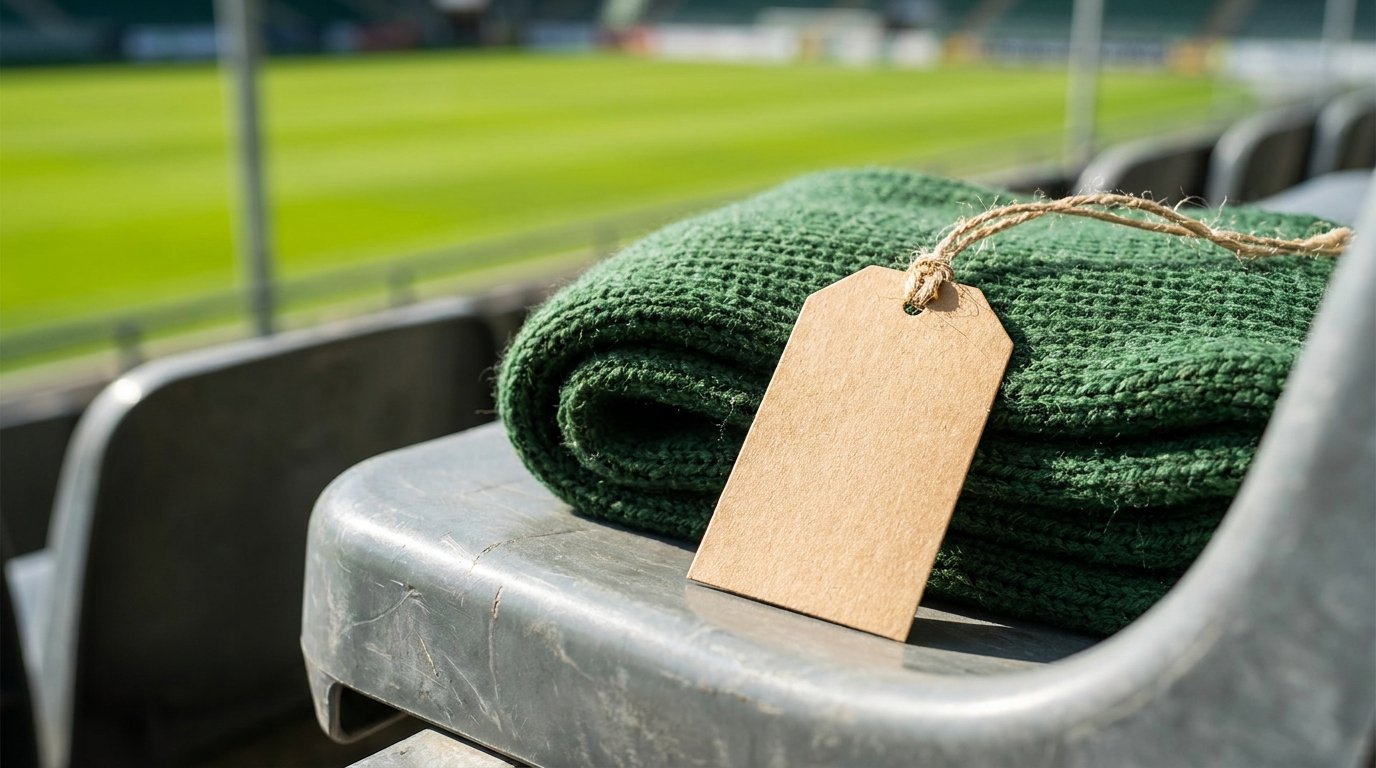
Take a hypothetical club scarf. Its hangtag shows a leaf and the words “Eco scarf”, with “Made from recycled materials” and “Climate-neutral production” on the back, and the webshop calls it sustainable. The supplier’s documents show a knitted body of 70% recycled polyester and 30% acrylic, a fringe and label of virgin polyester, and offset certificates bought for the order.
Every claim fails. “Eco” next to the leaf falls under point 4a, “made from recycled materials” under point 4b, the neutrality line under point 4c, and “sustainable” under point 4a with no realistic way out after recital 10. The rewrite keeps what can be proven:
- Front of the tag: crest and product name, without the leaf or “eco”.
- Back of the tag: “Knitted body: 70% recycled polyester, 30% acrylic. Fringe and label: polyester.”
- Webshop: the same line, and no “sustainable” in titles or filters.
- Climate: a club that funds a climate project reports it as a club investment on a separate page, without calling the scarf neutral.
- Stock already tagged: a sticker over the old lines, or a new tag.
Which Proof Should You Collect From Suppliers?
Collect the evidence before the claim goes out. Under Article 12 of the UCPD, member states give courts and authorities the power to demand proof of factual claims from the trader and to treat the claims as inaccurate without it. This section covers proof for claims, while the sourcing choices behind them are in our buyer guide to eco-friendly merchandising.
- Recycled or organic share: a certificate whose scope covers the product and the supplying site, a document that links your delivery to it, and a bill of materials with the share per component.
- Packaging claims: a component list that includes tape, windows, coatings and inserts.
- Durability lines: a test report that names the method and the result.
- Scheme logos: the scheme’s published terms and the permission to use the logo on this product.
- Future targets: the implementation plan and the independent expert’s latest findings.
Keep them in a claim register with channel, document, certificate expiry date and owner, and use the licensor’s artwork approval round to check claims too. For choosing the partner who supplies such documents, see our guide on how to choose a merchandise manufacturing partner.
Where an agency manages production, the claim check fits into steps that already exist. Am Ball, for example, inspects the raw material and checks the sample on-site at its partner factories before mass production starts, and the sample stage is the natural point to match each planned claim with its document.
A Five-Step Claim Audit Before the Next Season
A short routine before each season catches most problems while reprints are still possible:
- Collect every claim: hangtags, packaging, product pages, filters, marketplace listings, social posts, newsletters, shop signage, collection names and symbols next to text.
- Sort each claim into blacklisted, case by case or specific.
- Match each specific claim with its document, and delete what you cannot prove.
- Rewrite with the specification on the same tag, box or page; where there is no room for it, the Q&A says the claim should generally not be made.
- Fix old stock with stickers or new tags, brief licensees and suppliers, and re-check certificates before every reorder.
Frequently Asked Questions
Is “eco-friendly” still allowed on merchandise?
Only with recognised excellent environmental performance relevant to the claim, such as the EU Ecolabel, or with its specification in clear and prominent terms on the same medium, which makes it a specific claim that must still not overstate. On its own, it is banned towards consumers.
Does the EmpCo directive apply to B2B catalogues?
The directive covers business-to-consumer practices only, as the Commission’s Q&A confirms. In Germany, though, section 5 UWG also protects other market participants, and the 2024 Federal Court of Justice case concerned a trade newspaper ad. Catalogue text that reaches consumers through a webshop becomes a consumer claim.
Can we keep selling stock with old green claims?
Yes, once the claims are fixed. The rules apply from 27 September 2026 to products already made, ordered or on shelves, and the Q&A names stickers that cover or correct a claim, or supplementary information at the point of sale, as practical options.
Can a club still use its own sustainability logo?
Only if it is based on a certification scheme or established by public authorities. The scheme needs public terms, openness to all traders and monitoring by a third party that, according to the Q&A, must be a separate legal entity from the scheme owner.
Is the EU Green Claims Directive in force too?
No. The proposal, COM(2023) 166, would add rules on substantiating and verifying explicit claims, and the European Parliament’s Legislative Train lists it as blocked. It records that the Commission announced on 20 June 2025 that it intends to withdraw it, while the 2026 work programme lists it as pending.
Conclusion
The EmpCo directive turns green wording on merchandise into a question of evidence. Generic words, homemade badges, whole-product claims for one part and offset-based neutrality are out towards consumers, while a specific, true sentence on the same tag still works. In Germany, these UWG rules have applied since 27 September 2026, and competitors can enforce them with a warning letter.
If you are planning next season’s range, reach out to discuss licensing and production.


