
CHIO Aachen: How the Show Has Grown Since 1924
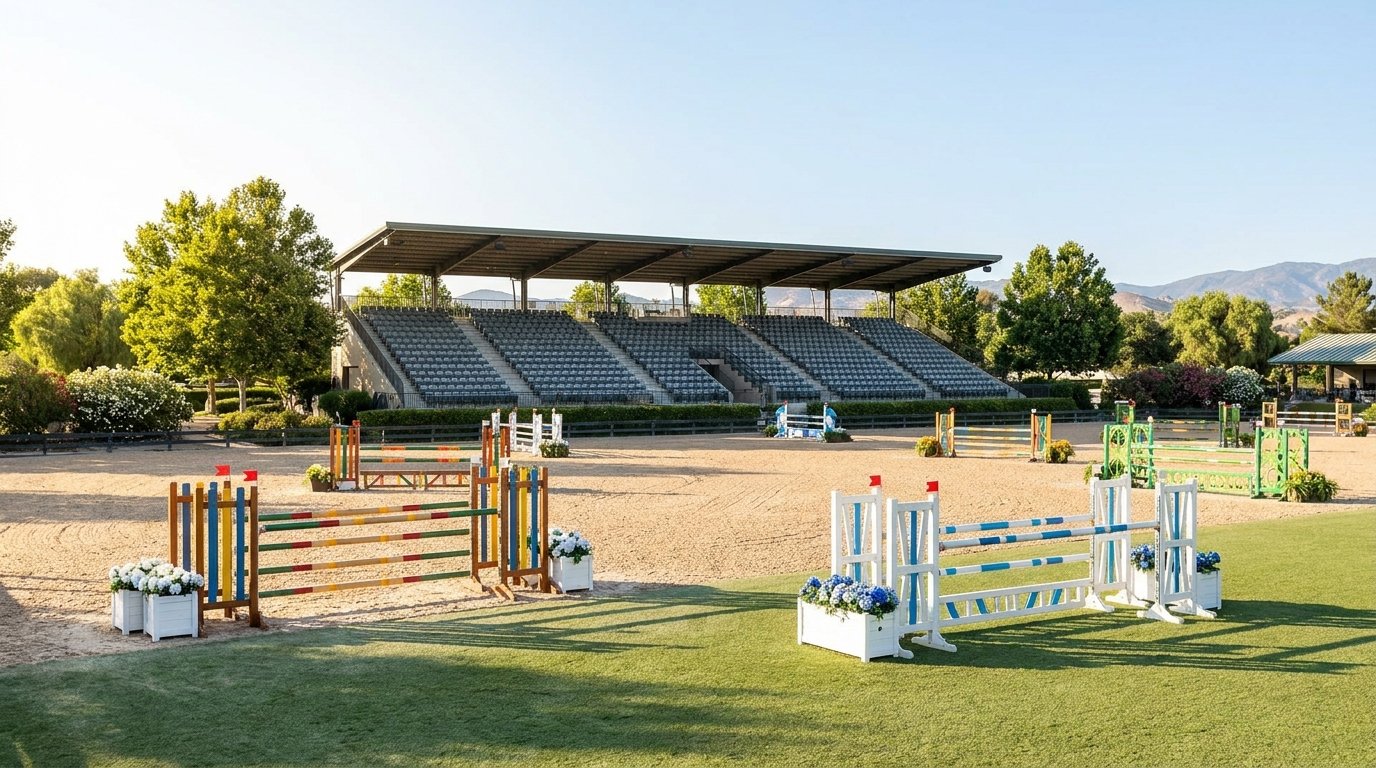
CHIO Aachen is one of the world's best-attended equestrian events, drawing around 350,000 spectators to Aachen's Soers showgrounds across ten days every summer.
It’s also one of the oldest. The organizing club dates back to 1898, and the event itself has run in something close to its current form since the 1920s, decades before most of what people now think of as major international sport existed in its current shape.
Key Takeaways
- CHIO Aachen is organized by the Aachen-Laurensberger Rennverein, founded in 1898.
- The first riding and driving tournament ran in 1924; international competition followed in 1927, and the first Nations Cup in 1929 (organiser’s timeline).
- The event now spans five disciplines, show jumping, dressage, eventing, vaulting, and driving, across ten days.
- The Rolex Grand Prix, CHIO Aachen’s marquee show jumping class, carried prize money of 1.5 million euros in 2025, part of a broader endowment of almost 3.9 million euros across the full ten-day programme (organiser fact sheet).
- CHIO Aachen is one leg of the Rolex Grand Slam of Show Jumping; a rider who wins three Majors in a row earns a 1 million euro bonus on top of prize money.
In This Article
- Key Takeaways
- What Is CHIO Aachen?
- How Did CHIO Aachen Become One of the World’s Best-Attended Equestrian Events?
- What Disciplines Does CHIO Aachen Cover?
- Why Does CHIO Aachen’s Scale Matter Beyond the Sport Itself?
- What Does a Long-Term Collaboration With CHIO Aachen Actually Involve?
What Is CHIO Aachen?
CHIO Aachen is an annual international equestrian festival held in Aachen, Germany, which its organiser calls the most famous riding tournament in the world. It runs across five disciplines over roughly ten days each summer at the Soers showgrounds, combining top-level sport with a scale of public attendance that few other equestrian events approach.
How Did CHIO Aachen Become One of the World’s Best-Attended Equestrian Events?
The Aachen-Laurensberger Rennverein, the club that still organizes CHIO Aachen today, was founded in 1898. It took until 1924 for the club to host its first riding and driving tournament, an event that, by the organiser’s account, drew about 20,000 spectators, a serious number for a regional equestrian competition at the time. International competition followed in 1927, and 1929 brought the event’s first Nations Cup, the team format that remains central to top-level equestrian sport a century later.
That near-century of tournaments, interrupted only by the Second World War (no tournaments between 1940 and 1946, per the organiser), and the reconstruction that followed, is part of what separates CHIO Aachen from equestrian events with a shorter or more interrupted history. Scale followed longevity: the organiser puts attendance at around 350,000 visitors across its ten days, with a record of about 370,000 reported for 2024 (MIKS Magazin), a scale few equestrian events approach.
What Disciplines Does CHIO Aachen Cover?
Five disciplines run across the ten-day programme: show jumping, dressage, eventing, vaulting, and driving. Show jumping draws the largest public profile, largely because of the Rolex Grand Prix, CHIO Aachen’s marquee class and one leg of the Rolex Grand Slam of Show Jumping, alongside the other Majors in Calgary (Spruce Meadows), Geneva and ’s-Hertogenbosch. A rider who wins three Majors in succession earns 1 million euros on top of the individual class’s own prize money, and a fourth in a row doubles it; the Grand Prix prize money at Aachen was 1.5 million euros in 2025.
That combination, genuine depth across five disciplines rather than a single headline event, plus prize money that rivals other major international sport, is a big part of why CHIO Aachen has kept its position at the top of the sport for a century rather than being overtaken by a newer, better-funded event elsewhere.
Why Does CHIO Aachen’s Scale Matter Beyond the Sport Itself?
An event running for a century, at this scale, with this kind of continuity, builds infrastructure most single-sport events never develop: a permanent showground, an established relationship with sponsors and broadcasters, and, relevant to anyone producing goods for the event, a settled annual production cycle that producers can actually plan around rather than negotiating from scratch every year.
What Does a Long-Term Collaboration With CHIO Aachen Actually Involve?
Am Ball has developed the CHIO Aachen Official Collection on an annual basis since 2020, a run of more than five years, long enough to move past one-off event merchandise into a genuine yearly production cycle. That relationship covers three things:
- Keychains, pins, and textiles, refreshed each year rather than reused as generic stock with a new date printed on it.
- The closing-ceremony handkerchiefs, white handkerchiefs for the festival’s closing “Farewell of Nations,” a tradition since 1953 in which spectators wave them as all athletes take a lap of honour, now one of CHIO Aachen’s own visual signatures.
- A settled annual cycle, production planned against a known calendar instead of a fresh negotiation every year, the kind of continuity that detail-heavy, small-batch collectible production depends on to hold quality consistently at that pace.
A specific piece that becomes part of how an event is remembered is what a collaboration produces once it has run long enough. Our overview of what a merchandise agency relationship actually involves covers how that kind of long-running relationship typically works, for readers evaluating one for their own event or federation.
Frequently Asked Questions
Is CHIO Aachen really the biggest equestrian event in the world?
Among the best-attended, yes. The organiser puts attendance at around 350,000 visitors across ten days at Aachen’s Soers showgrounds and calls it the most famous riding tournament in the world, though no independent ranking names it the largest.
How old is CHIO Aachen?
The organizing club, the Aachen-Laurensberger Rennverein, was founded in 1898. The first tournament ran in 1924, with international competition starting in 1927 and the first Nations Cup in 1929, making the event close to a century old in its current international form.
What disciplines are part of CHIO Aachen?
Five: show jumping, dressage, eventing, vaulting, and driving, all run across the same ten-day festival at the Soers showgrounds.
What is the Rolex Grand Slam of Show Jumping?
A bonus competition across four of show jumping’s biggest events: CHIO Aachen, the Spruce Meadows Masters in Calgary, CHI Geneva and The Dutch Masters in ’s-Hertogenbosch. A rider who wins three in a row earns 1 million euros on top of each class’s own prize money, and a fourth consecutive win adds another million.
Does Am Ball sell CHIO Aachen merchandise directly?
No. Am Ball produces the CHIO Aachen Official Collection, including the event’s traditional closing-ceremony handkerchiefs, but doesn’t operate direct-to-consumer sales for the event.
How long has Am Ball worked with CHIO Aachen?
Since 2020. Am Ball has produced the CHIO Aachen Official Collection, keychains, pins, and textiles, annually since then, alongside the event’s closing-ceremony handkerchiefs.
Conclusion
CHIO Aachen’s scale isn’t a recent development, it’s a century of continuity. It’s the result of the same organizing club running the same event for close to a hundred years, through a wartime pause that ended plenty of comparable institutions, and building the kind of depth, five real disciplines, genuine prize money, an actual permanent showground, that a newer or better-funded event still couldn’t replicate quickly. The white handkerchiefs waved at every closing ceremony are a small detail against that history, but they’re the kind of detail that only comes from a partnership that’s had years to become part of the event itself.
For a look at what that kind of multi-year event partnership actually takes to run, reach out to our team.


