
Sports Event Merchandise: What to Order, How Many and When
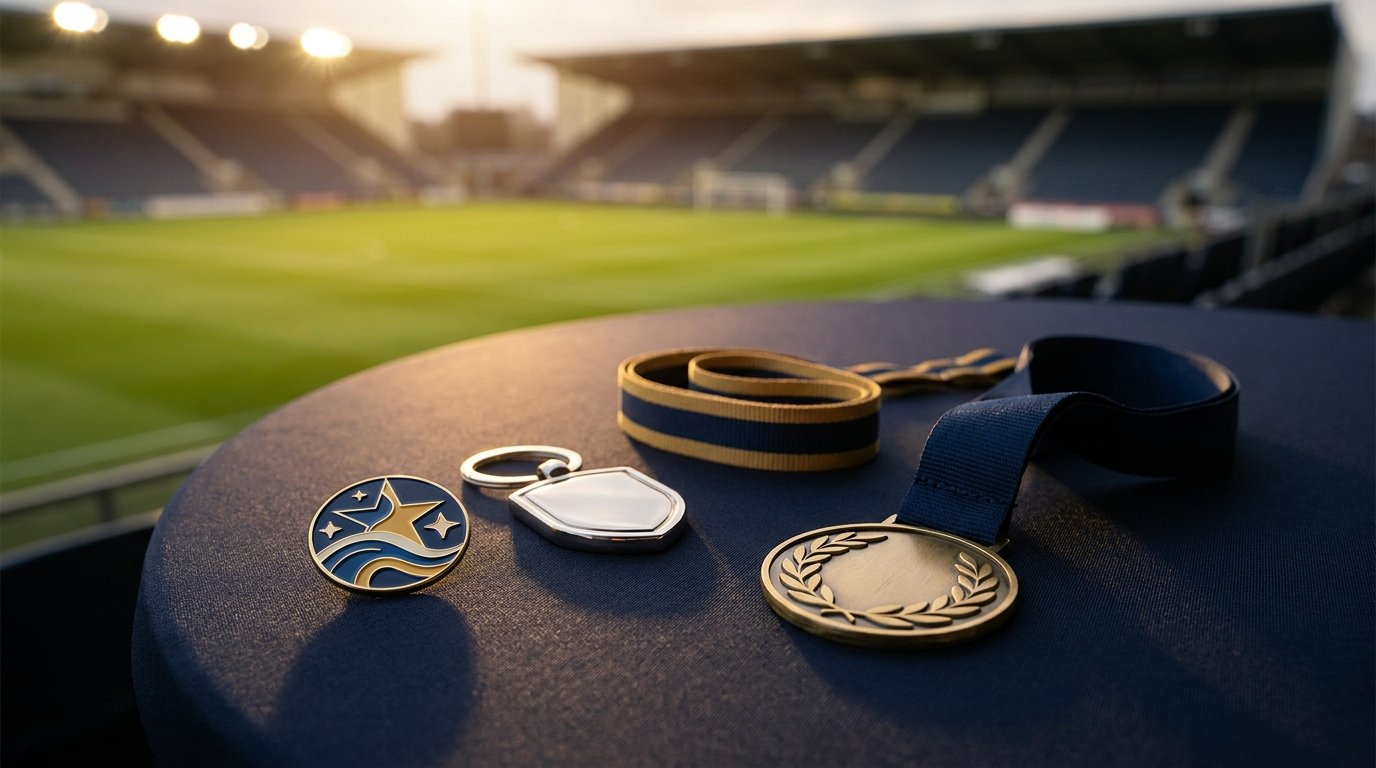
Event merchandise is the official range for one sports event or festival: products for fans, items for participants and officials, medals and awards, and gifts for partners and guests. It carries the event's marks, so the rights holder approves every design.
This guide is for federations, leagues, clubs and organisers that host a tournament, championship, final or multi-day event in Europe, and for the partner and hospitality teams around them. It shows how to split the range into segments, who approves what, how to set quantities and how to plan production back from the first event day.
Key Takeaways
- Plan event merchandise as four segments: fan retail, participants and officials, medals and awards, and partner and VIP gifts. Only fan retail needs a sales forecast; the other three come from lists you can count.
- The owner of a competition holds its names, logos, mascots and trophies, so every design and sample needs its written approval. Sponsors may also hold product categories that reach into your range.
- Medals have no second chance on the day. The competition format sets the count, not a forecast.
- Count back from the first event day. On average, a sample takes 2 to 3 weeks and series production about 4 weeks after sample approval; sea freight from Asia can take up to 3 months door to door, and approvals and a buffer come on top.
- Build the range around collectibles: pins, keyrings, medals, patches, lanyards and trophy replicas need no size run and still mean something after the final.
- Products sold to consumers in the EU fall under product safety and packaging rules, and goods made to your order under your marks can make you the party with the duties.
- Festivals and other multi-day live events follow the same plan, with artists and crew in place of teams and officials.
In This Article
- Key Takeaways
- How Should You Plan an Official Event Merchandise Range?
- Who Owns the Event Marks and Who Approves the Designs?
- What Event Merchandise Works Best at Sports Tournaments?
- How Many Pieces Should You Order?
- When Is the Right Time to Start Production?
- How Do Organisers Match Stock to Demand?
- Does the Same Plan Work for Festival Merchandise?
- Which EU Rules Apply When You Sell Event Merchandise?
How Should You Plan an Official Event Merchandise Range?
Split the range into four segments with their own rules: fan retail, participants and officials, medals and awards, and partner and VIP gifts. Each has its own audience, source of numbers, approval path and margin for error.
A single forecast, attendance times a buying rate, fits only the first segment. Teams, officials, medal winners and invited guests are lists you can count. Getting those lists right matters more than any single design, because every medal and every sponsor gift is noticed on the day.
The segments also differ in who signs off. Fan products need the rights holder’s approval and must meet consumer product rules, and a gift with a sponsor’s logo also needs the sponsor’s.
Who Owns the Event Marks and Who Approves the Designs?
The owner of a competition, usually the federation or league that runs it, holds its names, logos, mascots and trophy designs. Every product using them needs the owner’s prior written approval, often for artwork, sample and packaging.
UEFA’s 2026/27 Champions League regulations, hosted by the Spanish federation RFEF, show how far this reaches. UEFA is the exclusive owner of the competition’s intellectual property, which the text spells out as including names, logos, mascots, medals, plaques, commemorative items and trophies. Any use needs UEFA’s prior written approval, and the regulations give associating a club’s name with the date of a match as one example.
If you host an event that a federation owns, your hosting agreement sets what licensed merchandise you may make and sell, and the owner still signs off each design. If your organisation owns the event, decide early who approves merchandise and how fast, because every approval round sits on the critical path.
Sponsors are the second check. WIPO notes that events such as the Tour de France and Formula 1 races give sponsors wide product category exclusivity, so a partner’s contract can reach into your range. Before you fix the products, check which categories your partners hold and whether an item must carry, or must not carry, a partner’s logo.
The same WIPO page explains why approvals exist: licensors do not make the products, but they must ensure that licensees keep up the quality of everything that carries their trademark. In practice that means sign-off on artwork, a pre-production sample and often the packaging, and our guide to how sports merchandise licensing works walks through each stage. Names and images of players are often handled separately from the event’s marks, so clear them before they appear on a product.
What Event Merchandise Works Best at Sports Tournaments?
Build the range around collectibles: pins, keyrings, medals, patches, lanyards and trophy replicas. They need no size run, travel home in a pocket and keep their meaning after the final, which suits the short selling window of a tournament.
Apparel has its place, mainly as kit for participants, staff and volunteers, but every size and colour multiplies the stock you have to forecast. A collectible range works the other way round: one design idea can run as an undated core piece, a dated edition with the host city and year, and a final-day version, each with its own quantity. Enamel pins and keyrings are the natural base for such a series.
Final-day items are where a date pays off. The venue and date of a final are fixed when the schedule is published, so a pin, keyring or trophy replica with the host city and the year can follow the normal production timeline. Replicas of a real trophy need the trophy owner’s licence.
An item that names the winner can only go into production after the final. Sell it by pre-order with an honest delivery date, and keep it out of the opening order.
As an official UEFA licensee, Am Ball develops Champions League trophy replicas from 45 to 150 mm and, every season, new final products that carry the host city and the year. The same range includes co-branded replicas that put a club’s crest or a sponsor’s logo next to the competition emblem, a format that also works as a partner gift.
How Many Pieces Should You Order?
Count three segments and forecast one. Participant, official, medal and guest numbers come from squad limits, accreditation, the competition format and the guest list. Only fan retail needs a forecast, best made per design.
The examples below use a hypothetical international championship with 16 teams, six match days and the final on the last day. The same event returns in the timeline further down.
Participants and officials
Order from the maximum the format allows instead of waiting for names. With 16 teams and a limit of 30 accredited players and staff each, that is 480 welcome packs, plus referees, technical officials, volunteers and your own staff from the accreditation plan. Keep a small reserve for late changes, and leave personal details such as names to a late step.
Small groups stay affordable when they share a design. Ask whether one base pin or keyring can run in different colours for teams, officials and volunteers, and count lanyards as one per accredited person.
Medals and awards
The competition format fixes the count, and there is no second chance at the ceremony. UEFA’s Champions League regulations, hosted by RFEF, present the winning team with 50 gold medals and the runner-up with 50 silver. In the hypothetical championship, gold, silver and bronze for the top three teams, counting 30 players and staff each, make 90 medals, plus any individual awards and a reserve for pieces damaged in transit. Our guide to custom medals covers design, production and engraving.
Partner and VIP gifts
Count gifts from the guest list and the hospitality plan, in tiers: a sponsor’s chief executive, a hospitality guest and a journalist rarely get the same item. Make the base product on the main timeline and add names by engraving once the list closes.
Fewer, better gifts also cut waste. The giveaways chapter of the Guidelines on Sustainable Event Organisation by Germany’s Federal Environment Ministry and Environment Agency starts from the view that the most sustainable giveaway is the one never produced, and that a gift handed out at an event should not become waste soon afterwards. An engraved replica or a numbered pin set clears that bar more easily than a branded gadget.
Fan retail
Forecast fan retail per design. Start from what you can count: tickets sold, the last edition’s sales by item if there was one, and pre-orders for limited pieces. Put most of the volume into undated designs that can be sold after the event, and keep dated editions and final-day items to quantities you are confident of.
Each design carries its own fixed costs and minimum order quantity, so a few designs in solid runs cost less per piece than many small ones. Decide the top-up date before the first order, using the timeline below.
When Is the Right Time to Start Production?
Count back from day one. On average, a sample takes 2 to 3 weeks and series production about 4 weeks after approval. Approvals, up to 3 months of sea freight from Asia and a buffer come on top.
These production times are averages from the partner factories behind this guide, and they vary with the product, its complexity and the volume. In our experience, sea freight from Asia takes up to 3 months door to door, depending on route and season. Approval by photo can come within a day and typically takes a couple of days; when the rights holder wants the physical sample in hand, allow about 2 weeks.
Working back from the first event day
Take the hypothetical championship again. It opens on Thursday 1 July 2027, its metal goods are made in Asia and shipped by sea, and the rights holder wants the sample in hand. Series production runs into February, so the plan adds a 2-week factory pause around Lunar New Year on 6 February 2027, an assumption to check against the factory’s own dates.
With the full 3 months at sea and the sample held in hand, the right time to order the sample is by 30 December 2026, 26 weeks before the first event day, with the artwork approved a few days earlier; if the sample takes only 2 weeks, 6 January 2027 is early enough. A faster crossing gives you slack: goods that arrive in 6 weeks instead of 3 months gain about 7 weeks, and approval by photo saves most of the 2 approval weeks. The brief, quotes and design work come before all of this, so start them in autumn 2026.
Medals, gifts, top-ups and winner items
Medals and partner gifts run on the same timeline, because neither can be made on site. Names can be engraved late, which keeps the base product on schedule.
Top-up orders for fan retail work best when they are planned early. Assuming a repeat of an approved design needs no new sample or approval, a top-up placed by 3 February still arrives by sea before day one. That is the day the first order goes into production, long before sales data exist. If you want later top-ups, production in Europe is an option that shortens the shipping step; ask your supplier for door-to-door times.
Items that name the winner start after the final. A new sample, its approval, about 4 weeks of series production and shipping put them in fans’ hands weeks or months after the event, which suits a pre-order.
How Do Organisers Match Stock to Demand?
Keep dated designs in small runs, put most of the volume into undated designs, take pre-orders for limited pieces and set a top-up date. Agree a second life for any surplus before you place the order.
UEFA’s ESG report on EURO 2024 counts ordering among its waste measures: the organisers say they “made every effort to order the right quantities of all event materials” and ran a second-life plan for goods, uniforms and materials surplus to requirements. For VIP hospitality, UEFA adjusted food quantities to the teams playing and the time of day, which meant 40 fewer tonnes of food ordered. Counting per segment and per match day works the same way for merchandise.
These steps keep stock in line with demand:
- Keep the year and dates off long-life items such as core pins and keyrings, so they can be sold after the event and online.
- Number limited pieces, such as a final-day pin or a replica, and sell part of the run by pre-order.
- Agree in advance where surplus goes: thank-you packs for volunteers, partner packs, the next edition’s shop or your online store.
- Ask the supplier how long it keeps the tooling, so a design that sold well can be repeated without a new tool.
Collectibles make all of this easier. An undated pin has no leftover sizes and no season, so it can stay in the shop until it sells.
Does the Same Plan Work for Festival Merchandise?
Yes. Festivals and other multi-day live events use the same segments: fans, artists and crew in place of teams and officials, and partners and guests. Many return every year, so the range works best as an annual series.
An annual series combines a fixed core, such as a logo pin and a keyring that stay in the shop, with a new edition piece each year. Patches and pins for bags and jackets suit this pattern, and a lanyard can serve as crew accreditation in one design and as a fan collectible in another.
Am Ball has developed the CHIO Aachen Official Collection every year since 2020: keyrings, pins and textiles designed new for each edition, plus the white handkerchiefs that spectators wave at the closing ceremony. The handkerchiefs show what a multi-day event can add to its range: an item with a role in the event itself.
Artists and crew are counted like teams and officials, from the accreditation list. Items that name artists need their approval, and a line-up can change after production has started, so keep artist names to items made late or in small runs and let the festival’s own marks carry the core range. The product and packaging rules in the next section apply to festival merchandise in the same way.
Which EU Rules Apply When You Sell Event Merchandise?
Products sold to consumers fall under the EU’s General Product Safety Regulation, and their packaging under national packaging law. When goods are made to your order under your event’s marks, some of these duties can sit with you.
According to the European Commission, the GPSR has applied to consumer products since 13 December 2024, including products sold online. Each product needs a responsible economic operator in the EU: a manufacturer, importer, authorised representative or fulfilment service provider. Our guide to GPSR and nickel rules for metal pins and keychains explains why a club or brand that sells pins under its own name counts as the manufacturer, and what the product file needs.
In Germany, section 3 of the VerpackDG (in German) lists sports stadiums among the places that count like private households, so packaging that fans take home or throw away at the venue is treated like household packaging. The Central Agency Packaging Register (in German) states that anyone who sells packaged goods in Germany must be registered in its LUCID register. Agree in writing who registers before the first delivery.
Frequently Asked Questions
How far in advance should you order event merchandise?
Count back from the first event day: a sample typically takes 2 to 3 weeks, series production about 4 weeks on average and sea freight from Asia up to 3 months door to door, plus approvals and a buffer. In this guide’s example, the sample is ordered 26 weeks, about six months, ahead.
Do you need permission to put a tournament logo on merchandise?
Yes. The owner of the competition holds its names, logos and mascots, and each product needs its written approval. If you host an event that someone else owns, your hosting agreement sets what you may make and sell.
How many medals should you order for a tournament?
Take the count from the competition format: the places that win medals, the team size and any individual awards. Add a small reserve for damage in transit, because there is no time to reorder before a ceremony.
Can you make merchandise for the winner before the final?
Items with the host city and the year of the final can be made in advance. Items that name the winner can only go into production after the result, so they suit a pre-order delivered weeks or months after the event.
Conclusion
Event merchandise works best as four segments, three of which you can count. Clear the marks and sponsor categories first, count back from the first event day with up to 3 months for sea freight from Asia, and keep dated designs small.
If you are planning the range for a tournament, a final or a festival, talk to our team about your event range.


