
DFB-Pokal Trophy: Weight, Gold and the Official Replica
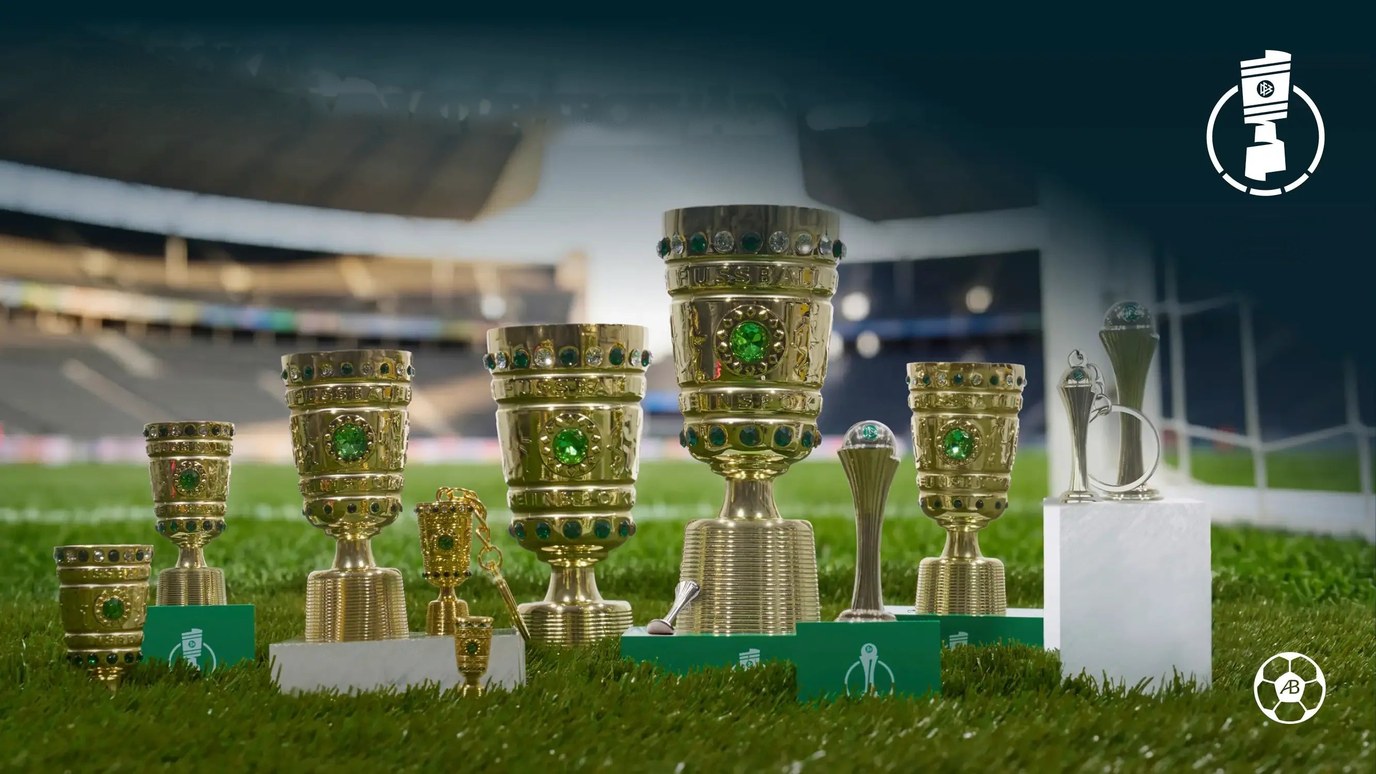
The men's DFB-Pokal trophy, awarded to the winners of Germany's national cup, weighs more than 6 kilograms according to its organisers, and 210 grams of that is pure gold. The women's trophy is heavier: 11 kilograms and 60 centimetres tall.
This article explains what the DFB-Pokal weighs and what it is made of, then follows the trophy from 1964 to today. After that come the women’s cup and the official replica: where it comes from and where to buy it.
Key Takeaways
- The men’s DFB-Pokal weighs more than 6 kilograms and holds almost 8 litres, according to the German Football Association (DFB). The DFB gives no height.
- It carries 210 grams of pure gold, 42 gemstones and a DFB emblem in jade. The gold is less than 4% of its weight.
- A Cologne goldsmith built it in 1964 to replace the Tschammer-Pokal, a relic of the Nazi era. After a fall in 2002, he repaired it for about €34,000.
- The women’s DFB-Pokal has been in use since 2010: 60 centimetres tall, 11 kilograms, silver-plated brass.
- The official DFB-Pokal replica comes in 70, 100 and 150 mm in the shop, plus a 45 mm keyring. The largest weighs 1.06 kilograms.
In This Article
- Key Takeaways
- How Heavy Is the DFB-Pokal Trophy?
- 210 Grams of Gold and 42 Stones
- What the Trophy Has Been Through Since 1964
- The Women’s DFB-Pokal: 60 cm and 11 kg
- The Official DFB-Pokal Trophy Replica
- Where to Buy the Official Replica
How Heavy Is the DFB-Pokal Trophy?
More than 6 kilograms. That is the figure on the DFB’s page on the men’s cup (in German). Other figures circulate online; this article sticks to the current figure from the DFB, which runs the competition.
The DFB gives no height on that page. It does say how much the cup holds: almost 8 litres of liquid.
The women’s trophy is heavier. It weighs 11 kilograms.
210 Grams of Gold and 42 Stones
Gold is only a small part of that weight. According to the DFB’s English-language page on the cup, the trophy carries 210 grams of pure gold, 12 tourmalines, 12 rock crystals and 18 nephrites, plus a DFB emblem stamped in jade. That makes 42 stones, not counting the emblem. The DFB itself heads its description “Object of desire”.
To put that in proportion: 210 grams out of more than 6 kilograms is less than 4%. The DFB-Pokal is not a solid gold cup. The DFB does not say what metal its body is made of.
Art experts put its material value at about €35,000, according to the DFB. The prize money is many times that: for the 2024/25 season the DFB set aside nearly €11 million for the cup winner across all rounds, the same English-language page says.
Its symbolic value is far higher. The DFB ranks the cup as the most coveted trophy in German football after the Meisterschale, the Bundesliga’s championship shield.
What the Trophy Has Been Through Since 1964
The competition dates back to 1935. According to the DFB’s English-language page, 1. FC Nürnberg won the first final 2-0 against Schalke 04. After the war, the DFB went on handing the winners the so-called Tschammer-Pokal for years.
By 1964, the DFB wanted this remnant of the Nazi era gone. It commissioned a Cologne goldsmith to build a trophy that met the association’s cultural standards. Dortmund’s Alfred “Aki” Schmidt was the first to lift it, in 1965, at the final in Hanover. The final has been held at Berlin’s Olympiastadion every year only since 1985.
After that, the trophy grew with its winners. Each winning team is added to the base, and after almost 30 years space ran short. In 1991 the base was enlarged by 5 centimetres. According to the DFB’s German page, that should leave room for every winner until at least 2030.
In 2002 the trophy was badly damaged. During the celebrations after FC Schalke 04 beat Bayer Leverkusen in the final, it fell off a low-loader onto the street. Scratched and dented, it could not be passed on to the next winner.
The Cologne goldsmith took it on again. According to the DFB, the repair took about five months and well over 600 working hours. The bill came to about €34,000, almost as much as the estimated material value.
The Women’s DFB-Pokal: 60 cm and 11 kg
The women’s trophy is younger and heavier. According to the DFB’s page on the women’s cup (in German), it has been in use since 2010, stands 60 centimetres tall and weighs 11 kilograms. Forty-eight teams compete for it.
It is made of silver-plated brass. A ball with the DFB logo in enamel sits on top, and the stepped base carries the names of past winners. The DFB describes the shape as strongly waisted, with lines that rise and continue over the ball.
Its direct predecessor was much lighter. The first women’s trophy, in 1981, was a document roll in 925 sterling silver with a laurel branch. In 1994 a cup about 45 centimetres tall and weighing about 3 kilograms followed, awarded until 2009. It was made of two interlocking half-shells with the inscription “Vereinspokal Damen” (women’s club cup) and nine chrysocolla plates, gilded inside, and held about 4 litres.
Today’s trophy weighs almost four times as much as that predecessor.
The DFB gives material values too: €30,000 for today’s trophy, about €10,000 for its predecessor. According to the DFB, the next women’s final is on 17 May 2027 at Cologne’s RheinEnergieStadion.
The two trophies side by side, using the DFB’s figures:
The Official DFB-Pokal Trophy Replica
Both trophies also come in a size for a display cabinet at home. The official replicas of the DFB-Pokal and the women’s DFB-Pokal come from Am Ball. The Munich company, which has specialised in licensed collectibles for more than 25 years, is the DFB’s exclusive licensee for both replicas.
Its DFB case study shows the men’s replica in sizes from 45 to 150 mm, with or without a pedestal. In the shop, the smallest size, 45 mm, is a keyring. The largest replica weighs 1.06 kilograms; the original weighs more than 6. The green and white decorative stones follow the original’s and catch the light.
"Anyone with a DFB-Pokal replica in their display cabinet looks closely: at the engraving, the setting of the stones, the edges of the base. So every detail has to be right," says Dominik Mittermaier from our team.
Exclusive means a single licensee holds the licence for these replicas. Our guide to federation merchandise covers how a federation such as the DFB plans and approves licensed products.
For the women’s cup, the case study shows a pin, a keyring and a replica with the original’s slim, upward silhouette. What a licence decides during production, from the rights holder’s specifications to sample approval, is the subject of our article on official trophy replicas.
Where to Buy the Official Replica
The DFB-Pokal replicas are in the webshop at shop.amball.com. They come in 70, 100 and 150 mm, each freestanding or on a green acrylic pedestal, alongside a 45 mm keyring, a pin and a magnet. Every piece there is officially licensed, the case study says.
Which size suits depends on the space. The shop pitches the 70 mm replica at desks and shelves. At 150 mm the details show best, the stones included.
The women’s cup has a collection of its own: the replica in 70 mm, with or without an acrylic pedestal, plus a pin and a keyring. The keyrings, pins and magnet are made of Zamak, a zinc alloy, and come on an official DFB card.
You can check whether a piece is officially licensed. Our guide shows how to spot counterfeit licensed merchandise.
Frequently Asked Questions
How much gold is in the DFB-Pokal?
210 grams of pure gold, according to the DFB. With a total weight of more than 6 kilograms, that is less than 4%. The rest of the decoration is 42 stones and a DFB emblem in jade.
Is the women’s DFB-Pokal heavier than the men’s?
Yes. The women’s trophy weighs 11 kilograms; the men’s weighs more than 6, according to the DFB. The men’s trophy still has the higher material value: about €35,000 against €30,000.
How tall is the DFB-Pokal?
The DFB’s page gives no height for the men’s trophy. It does say the cup holds almost 8 litres and that its base was enlarged by 5 centimetres in 1991. The women’s trophy is 60 centimetres tall, and the largest official replica of the men’s cup is 150 mm.
How much is the DFB-Pokal worth?
Art experts put its material value at about €35,000, according to the DFB. The 2002 fall showed what damage costs: the repair came to about €34,000.
Where is the DFB-Pokal final played?
The men’s final has been played at Berlin’s Olympiastadion every year since 1985. The women’s final is held at Cologne’s RheinEnergieStadion.
Does the winner keep the DFB-Pokal?
No. The winning team is added to the base and the trophy passes to the next winner. That is why it had to be repaired after the 2002 fall before the DFB could award it again.
Who makes the official DFB-Pokal replica?
The official replicas of the DFB-Pokal and the women’s DFB-Pokal come from Am Ball in Munich, the DFB’s exclusive licensee for both replicas. The men’s replica comes in 70, 100 and 150 mm; the largest weighs 1.06 kilograms. The women’s replica measures 70 mm.
Conclusion
The DFB-Pokal trophy weighs more than 6 kilograms, and less than 4% of that is gold. Its worth lies more in the names on its base: according to the DFB, the trophy gains value year after year with every winning team added there.
For a display cabinet at home, the official replicas of both trophies are in the webshop. If you are planning replicas or trophies of your own for a federation or a competition, talk to our team.


