
Football Federation Merchandise: What to Make, Who Approves
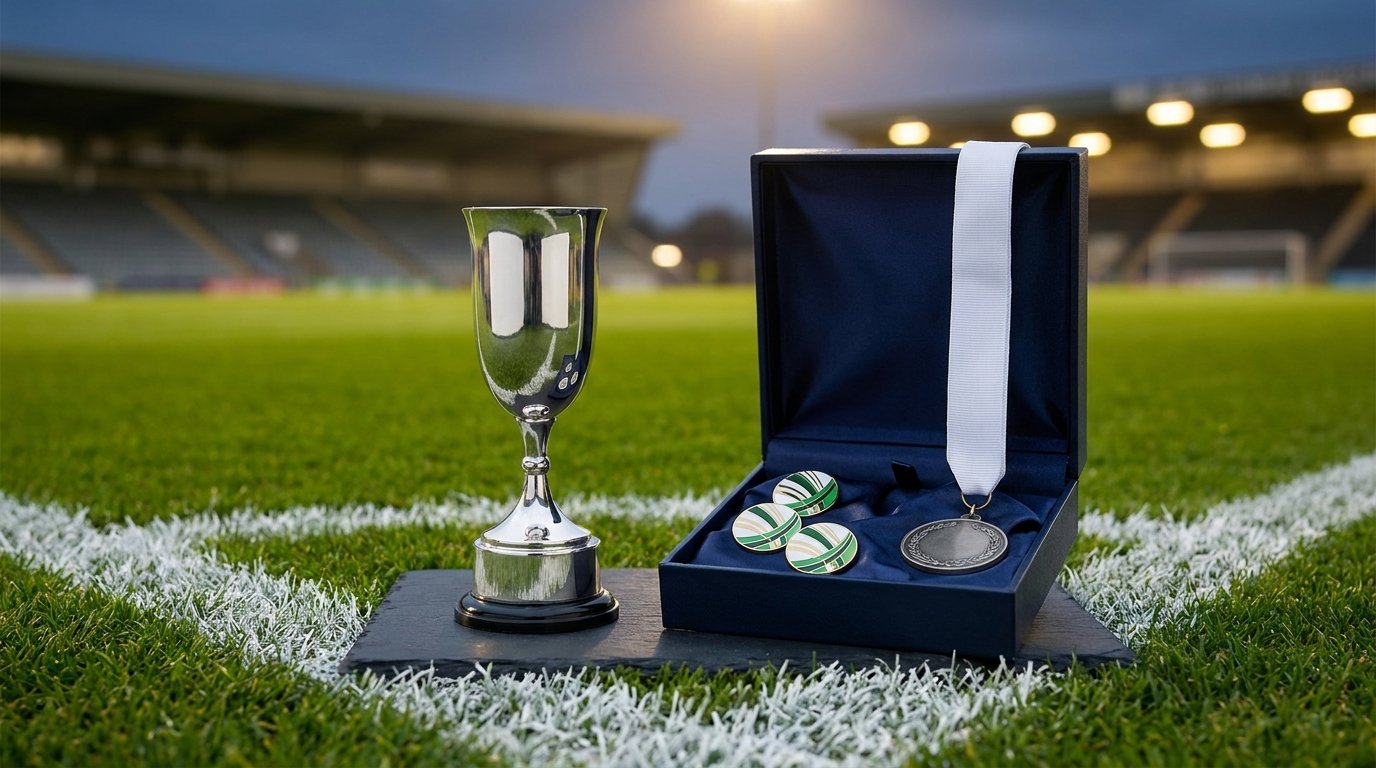
Football federation merchandise is every product that carries a national association's marks: fan ranges for its national teams and cup competitions, tournament collectibles, gifts for partners and guests, and the medals for its own competitions.
This guide is for licensing, marketing and event teams at national football federations, and for the agencies and licensees that work with them. It sets out the five product families a federation usually needs, who approves each one, how women’s football fits in, and how to plan a cup-final range from the right order date backwards.
Key Takeaways
- A national federation needs five product families: national team ranges, cup competition ranges, tournament and anniversary collectibles, partner and VIP gifts, and medals and awards for its own competitions.
- The federation is the licensor. Its commercial company or marketing unit usually runs the programme, and its partner contracts define categories that licensed products must respect.
- A national cup trophy is a collectible that fans of every club in the country recognise. Replicas in several sizes, from a pocket pin to a display piece, cover fans, partners and winners.
- Women’s football works best as its own line with its own trophy, not as a variant of the men’s range.
- On average, a sample takes 2 to 3 weeks and series production about 4 weeks after approval. Federation reviews, holidays and shipping come on top.
- For a cup final in late May 2027 with goods made in Asia and shipped by sea, the right time to submit concepts is by 14 November 2026.
In This Article
- Key Takeaways
- What Does Football Federation Merchandise Cover?
- Who Approves Football Federation Merchandise?
- National Team and Cup Ranges: Licensed Products for Fans
- Women’s Football Merchandise as Its Own Line
- Tournament and Anniversary Collectibles
- Partner and VIP Gifts
- Medals and Awards for Federation Competitions
- Football Federation Merchandise for a Cup Final: The Right Time to Order
What Does Football Federation Merchandise Cover?
Football federation merchandise covers five families: national team ranges, cup competition ranges, tournament and anniversary collectibles, partner and VIP gifts, and medals and awards. Each has its own audience, approver and calendar.
A club sells to one fan base on one fixture list. A federation sells to the whole country, often for several teams at once (men, women, youth), and it also owns competitions that every club in the country plays in. That is why its range is wider, and why the approval chain matters more.
The market behind it is growing. Licensing International’s 2026 Global Licensing Industry Study reports that the sports property category grew 8.5% in 2025 to 44.4 billion dollars, the fastest growth of any property type, and now holds 11.4% of the licensing market.
Who Approves Football Federation Merchandise?
The federation approves, as owner of the marks. In practice, its commercial company or marketing unit runs the licensing programme, sometimes with an outside licensing agency, and checks every product against its partner contracts.
Our guide to how sports merchandise licensing works explains the stages: concept, pre-production sample, production sample and packaging. For a federation, three parties shape those stages.
The federation and its commercial arm
Some federations run their commercial business through a separate company. At the DFB, partnerships are announced by the chair of the management board of the DFB GmbH und Co. KG, as in the announcement of its national team nutrition partner. Ask early which team reviews designs, sets the brand rules and signs off samples, because that is who your concept goes to.
Partner categories
Federations sell partnerships by category. The DFB names a nutrition partner for its men’s national team and a personal care partner for its women’s and men’s national teams. A licensed product that touches a partner’s category, such as a drinks bottle or a care set, needs checking against those contracts before the design starts.
Kit and apparel rights
Team apparel and replica shirts often sit with separate contracts. Ask the federation which product categories are already granted before you brief a range, so the concept goes to the right team and the licence covers every item in it.
National Team and Cup Ranges: Licensed Products for Fans
National team ranges run on the international calendar, and cup ranges run on the cup season. Both work best when built around one recognisable object: the crest for the team, the trophy for the cup.
A national cup reaches every club in the country, so its trophy becomes a shared symbol. The Scottish FA describes the Scottish Cup as the oldest existing trophy in association football, first played for in the 1873/74 season. A trophy with that much history is a collectible before anyone designs a range around it.
Trophy replicas are the core of a cup range, because one design scales from a pin to a display piece. Am Ball, a Munich merchandising agency for clubs, federations and brands, specialised in custom and licensed metal collectibles since 1998, is an official licensee of four national federations: the DFB (men’s national team, DFB-Pokal, women’s DFB-Pokal), the French federation FFF (national team, Coupe de France, Coupe Gambardella, women’s football, and the lines for France’s 1998 and 2018 world titles), the Spanish federation RFEF (national team, Copa del Rey, Supercopa) and the Scottish FA (Scottish Cup). Its DFB case study shows DFB-Pokal replicas from 45 to 150 mm, with or without a pedestal, the largest weighing 1.06 kg, with the green and white decorative stones reproduced to catch the light like the original’s.
For the national team, the same case study shows a different approach: pins, keyrings, lanyards, magnets and mini kits in one visual language agreed with the DFB, packed on matching header cards and bundled into fan sets. Consistent packaging lets a federation sell many small items as one range.
Women’s Football Merchandise as Its Own Line
Women’s football works best as its own line, built on its own trophy and teams. It has its own calendar, its own audience and, at the DFB, its own strategy.
The DFB’s strategy for women in football, FF27, sets four goals, including doubling the media reach of women’s football across all platforms, and it covers marketing at every level of the game. Merchandise is one of the most visible ways to show that reach on the street.
Am Ball’s women’s DFB-Pokal line, shown in the same case study, follows this approach: a pin, a keyring and a trophy replica of the women’s cup, with its slim, upward silhouette, tied to the FF27 strategy. The FFF range described above also treats women’s football as a category of its own.
For the market data behind this, from Deloitte’s women’s club rankings to tournament ticket sales, see our analysis of women’s football merchandise and licensing in 2026. Start with a small range around the cup and the national team, and add pieces as attendance and reach grow.
Tournament and Anniversary Collectibles
Tournament collectibles carry a year and an occasion, so they sell around the event and then become memorabilia. Anniversary pieces mark a title, a founding date or a jubilee season, and they suit collectors more than casual fans.
Dated pieces work best in limited runs. Put most of the volume into undated designs that keep selling after the tournament, and use the dated pieces, such as a pin with the host country and year, as the collectibles that make the range feel current.
Anniversaries of national titles are strong occasions for a federation. The licensed lines for France’s 1998 and 2018 world titles, part of the FFF range above, show how a past success can stay in a range for years.
For tournaments that a federation hosts or takes part in, the planning steps, quantities and timing are the same as for any event. Our guide to sports event merchandise planning covers the four event segments and how to count back from day one.
Partner and VIP Gifts
Partner and VIP gifts are counted, not forecast. The number comes from the partner list, the hospitality plan and the guest list for each match or final.
Gifts work best in tiers. A partner’s chief executive, a hospitality guest, a delegation from another federation and a journalist rarely receive the same item. A boxed trophy replica on a pedestal suits the top tier; a pin set or an engraved keyring suits the larger groups.
Partners also run their own campaigns with the federation’s marks. The DFB’s nutrition partner, for example, plans exclusive collecting campaigns in World Cup and European Championship years. Those products go through the same approval chain as the federation’s own range, so plan them on the same timeline.
Medals and Awards for Federation Competitions
Medals and awards are the products a federation needs for its own competitions: cup winners and finalists, youth and women’s competitions, referees and long-service honours. The competition format sets the count.
Medals have been part of the cup tradition from the start. The Scottish FA notes that the Scottish Cup trophy was bought together with a set of medals for the first competition in 1873/74. A federation’s medal needs today run from the national final to youth and regional competitions.
A medal needs its own decisions: struck or cast, relief, enamel colours, plating, ribbon and engraving. Our guide to custom medal design and production explains each choice and what the tooling fixes. Add a small reserve for each ceremony, since there is no time to reorder before the presentation.
Football Federation Merchandise for a Cup Final: The Right Time to Order
Count back from the date you want the goods in hand. With goods made in Asia and shipped by sea, a cup final in late May needs concepts submitted the previous November.
Take a hypothetical federation with a cup final on Saturday 29 May 2027. It wants a fan range (pins, keyrings, two replica sizes), boxed replicas for partners and medals for both finalists, all in hand two weeks before the final. The production times below are averages for metal goods at the partner factories behind this guide and vary by product and volume.
Two of these figures are assumptions: the two weeks for the federation’s concept review (ask its licensing team how long a round takes) and the two weeks for the factory’s holiday around Lunar New Year (ask your partner for its closure dates). The sample approval also falls in the Christmas holidays, so name the approvers in advance.
The right time to submit concepts in this example is therefore 14 November 2026, 28 weeks before the final. If production at a European partner factory suits the range, the transport time shortens; the price is usually higher. Winners’ items that name the champion can only go into production after the final, so offer them as a pre-order.
Orders for metal collectibles typically start around 300 units. For a cup range, it often pays to keep fewer designs in larger runs, with the dated final pieces kept small.
Frequently Asked Questions
Who owns the rights to a national team’s crest and name?
The national federation owns its crests, team names, competition names and trophy designs. Every product that uses them needs its written approval, usually through its licensing or marketing team.
Can a federation commission its own merchandise instead of licensing it?
Yes. A federation that holds the rights can commission production under its own brand rules, for example for partner gifts or medals. A licensed production partner can manage design, samples and quality control on its behalf.
How long does federation merchandise take to produce?
On average, a sample takes 2 to 3 weeks and series production about 4 weeks after sample approval, depending on complexity and volume. Federation reviews, holidays and shipping come on top, and sea freight from Asia can take up to 3 months.
What is the minimum order for federation collectibles?
Orders for metal collectibles such as pins, keyrings and medals typically start around 300 units. Ask for a quote per design and quantity, since tooling is made for each design.
Should women’s football have its own merchandise range?
Yes, it works best that way. A women’s range built on its own cup and teams speaks to its own audience, as the DFB’s women’s DFB-Pokal line shows. Start small and grow with attendance.
Conclusion
Football federation merchandise works best when each of the five families has a clear audience, approver and date: national team and cup ranges for fans, women’s football as its own line, dated collectibles in small runs, counted partner gifts and medals for every competition. Clear partner categories first, then count back from the date you need the goods.
If your federation is planning a cup, national team or women’s football range, talk to our team about licensed collectibles for your federation.


